Case Studies Community Credit Union Cuts New-Hire Turnover in Half with Structured Hiring
The Challenge
A community-focused credit union was looking for stronger talent signals to hire the right talent across its growing retail network. As a certified Community Development Financial Institution (CDFI) with 200+ employees, more than 60% of its net profit must be reinvested into the local community, so every hiring decision carries real impact for members and staff. The organization’s mission – helping people prosper, helping communities thrive – demands employees whose potential, values, and skills align with its mission, not just their resume.
Before partnering with Criteria, recruiting was decentralized and fragmented, with hiring responsibilities shared among multiple HR generalists. Each recruiter approached screening a little differently, there were no standardized tools to evaluate candidates, no objective signal to separate strong candidates from weak ones, and the process lacked a clear, repeatable pathway from application to offer. Initial pre-screening relied heavily on time-intensive manual phone screens, and simply scheduling those conversations could take over a week for a single candidate, especially when juggling candidate and recruiter availability.
At the same time, the credit union was seeing high new-hire turnover, particularly in early tenure. From 2023 to 2024, new-hire turnover reached 52%, and although it dropped to 31% the following year, the team knew they needed stronger talent signals to sustain progress. High early-tenure turnover isn't a retention problem – it's a selection problem. And the credit union knew it.
The HR team wanted a way to:
- Make the hiring process faster and more efficient
- Improve consistency and fairness across branches and roles
- Hire people who fit the organization’s mission and culture
- Maintain a positive, flexible candidate experience
To reach those goals, they looked for a solution that would combine objective, research-backed assessments with a more scalable, predictive interview process.
The Solution
The credit union partnered with Criteria and rolled out a comprehensive suite of assessments along with Async Video Interviewing paired with Criteria's automated AI Scoring add-on. In 2025, they began introducing Criteria into their hiring process for a wide range of roles, with a particular focus on entry-level retail positions such as tellers. Their aim was to create a standardized, mission-aligned process that could be applied consistently across all branches.
For retail staff, the team now uses a core assessment package that includes:
- CLIK (Computer Literacy and Internet Knowledge): To evaluate basic skills and aptitude for frontline banking work.
- EPP (Employee Personality Profile): To understand candidates’ work styles and how they might serve members and colleagues.
- Game-based assessments: To measure cognitive and behavioral traits in a more engaging, candidate-friendly format.
- Illustrait: To assess alignment with specific competencies tied to the organization’s mission and the demands of each role.
To fine-tune this framework, HR worked to define which competencies were truly essential before bringing someone in for an interview. They then configured Illustrait around those target competencies so that candidates who advanced shared a common baseline of potential and cultural fit. For specialized positions, they also leveraged tools like CCAT and EPP, guided by O*NET-aligned job profiles, to build assessment batteries tailored to more complex responsibilities.
Async Video Interviewing with AI Scoring plays a central role in their new process. Instead of manually scheduling and conducting live phone screens, the team invites candidates to complete a structured video interview, using a consistent set of questions and rubrics. Candidates can complete the video interview on their own time, often in the evenings or on weekends, which removes the pressure of taking a call from their current workplace. Once candidates submit their video responses, Criteria's AI Scoring evaluates and scores each interview objectively before being reviewed by a human recruiter.
The Results
This approach significantly changed how time is spent recruiting. More of the HR team’s effort goes into designing roles and selecting assessments upfront, while AI and automation handle much of the early-stage screening.
“[The AI Scoring] – I absolutely love it. It's my favorite thing in the world. We use it almost for every position now.”
This shift has allowed their HR team to be more human in the process: AI manages the administrative load and scoring so HR team members can devote more attention to interviews, relationship-building with candidates, strategic alignment with leadership, and to making confident, defensible hiring decisions backed by evidence, not gut feel.
After using Criteria for less than a year, the credit union saw substantial improvements across new-hire turnover, time-to-hire, quality of hire, and candidate experience:
Reduced New-Hire Turnover
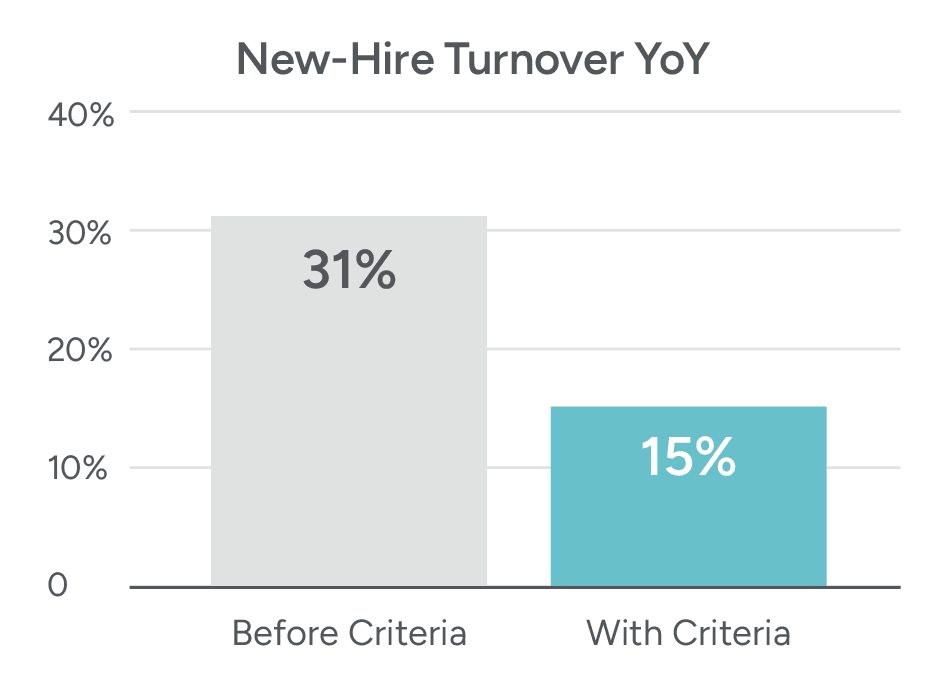
The most striking impact has been on new-hire retention. Between 2023 and 2024, new-hire turnover stood at 52%. In the following year, 2024 to 2025, that figure dropped to 31%, showing the organization was already trending in the right direction.
From 2025 to 2026, after Criteria was implemented and adopted into the majority of new-hire processes, new-hire turnover is just 15%. (The HR team calculated that it would have been about 21% if the organization had continued with its previous approach.) The credit union effectively cut new-hire turnover in half compared to the prior 31% year and materially outperformed its own projected baseline.
Out of 53 new hires during that timeframe, just one left due to performance issues. All other departures were voluntary, suggesting that the combination of assessments and structured interviews helps the organization identify candidates who are both capable and aligned with the credit union’s mission and day-to-day realities.
Time Savings and Faster Hiring
The new process also saves significant time for the HR team and hiring managers. Previously, scheduling a phone screen could take around a week and a half for a single candidate, with recruiters waiting on emails, juggling calendars, and coordinating time slots. Because those phone screens were live, recruiters also had to split their attention between asking questions, taking notes, and evaluating responses in real time.
With Async Video Interviewing and AI Scoring, candidates complete their video interview within a three-day window, and HR can review the AI-graded responses when it fits their schedule. Pre-screening, which used to take up to two weeks, has been reduced to around 3 days for most roles. Evaluating each candidate’s interview typically takes about 20 minutes, and even highly specialized roles can be evaluated in less than 40 minutes.
Recruiters are able to confidently send strong candidates to hiring managers quickly, which shortens the overall time-to-decision. The team also benefits from the flexibility that comes with candidates completing interviews outside standard business hours, which keeps processes moving even when HR is offline. When the talent signals are right, the decision is easy - and fast.
Higher Quality of Hire and Smoother Onboarding
The combination of multiple assessments, consistent competencies, and structured video interviews has led to sharp improvements in quality of hire. The Credit Union’s HR leader describes the impact as “astronomical” and notes that nearly every new hire is performing well in their role. Because the process now filters for both aptitude and comfort with technology, new employees arrive better prepared for the digital tools they will use on the job.
This has had a noticeable effect on onboarding. In orientation and early training, HR no longer spends significant time teaching basic computer skills. Instead, sessions can focus on higher-value, job-specific training: the credit union’s history, regulatory topics, and the mission-driven approach to serving members and the community. Since using Criteria, new hires absorb this information more quickly and can start contributing sooner.
Positive Candidate Experience, Strong Internal Buy-In
Adding assessments and a video interview has been a positive candidate experience, with applicants noting that the platform was easy to use and guided them through each step. Many appreciate the ability to complete interviews at times that work for them (late evenings, early mornings, or weekends) without needing to take calls at work for another job opportunity.
This flexibility supports a more inclusive process and naturally surfaces candidates who are comfortable navigating the technology they will encounter in their roles.
Internally, Criteria’s analytics make it easier for HR to demonstrate the value of the new approach. This visibility reinforces leadership’s trust in the process and clearly highlights HR’s impact on both hiring outcomes and business goals.
___
Based on these results — dramatically lower new-hire turnover, faster and more consistent hiring decisions, stronger performance from new employees, and sustained candidate satisfaction — the credit union plans to continue expanding its use of Criteria's talent signal platform across roles and branches. By replacing gut feel and resume screening with science-backed potential, skills, and performance signals, the organization has built a hiring foundation it can trust, scale, and defend — one that doesn't just fill roles, but advances its mission.