Every year, employers hiring early-career talent do something remarkable. They open the doors to thousands of candidates, sort through an avalanche of applications, and try to select the people who will become their future leaders. They do it on tight timelines, with lean teams, and with an incoming class that needs to be right the first time.
It's a high-stakes job that has never been easy. But in 2026, it’s changing faster than most graduate programs have been able to keep up with.
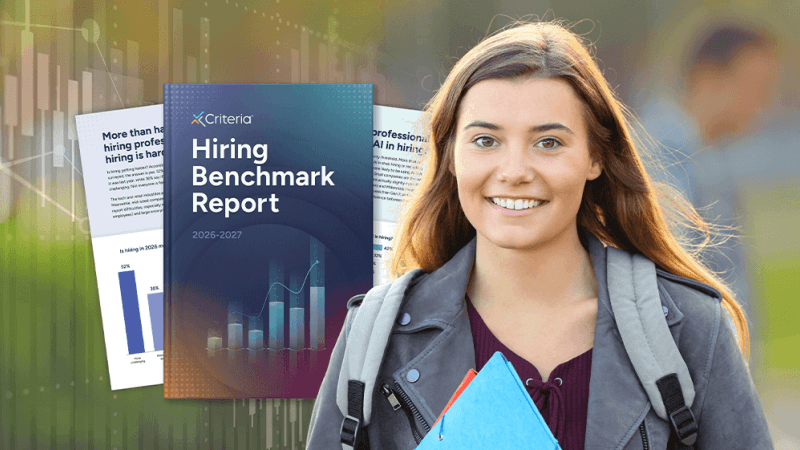
Criteria’s 2026-27 Hiring Benchmark Report surveyed 1,027 hiring professionals, revealing the pressures that employers are facing, and they’ll feel very familiar to anyone involved in campus and early-career recruiting. These pressures include rising application volumes, AI-polished submissions, an ongoing debate about graduate readiness, and a growing need to identify potential rather than rely on past experience.
The report’s central message is that the organizations that pull ahead will be the ones that trade guesswork for evidence. Here is what the research tells us, and what it means for employers hiring graduates at scale.
Hiring is harder, even as growth plans return
More than half of hiring professionals (52%) say hiring is harder in 2026, yet nearly two-thirds expect their organizations to grow headcount over the next year. The biggest challenge is not a lack of applicants; it’s finding high-quality candidates with the right skills which 55% of hiring professionals report struggling with.
That distinction matters for graduate programs. Most of you aren’t short on applications. You’re swimming in them. The challenge is knowing which applicants have the potential to succeed and finding them before they accept another offer.
The signal problem: when every application looks perfect
A major reason hiring feels harder now is because traditional signals have become noisy. 4 in 10 hiring professionals report struggling with candidates using AI to misrepresent themselves.
Many graduates see AI as a sensible tool to tidy up their resume or draft a cover letter, and most aren’t trying to do anything dishonest. But the problem is that a polished, keyword-perfect application tells you very little about the real person behind it. When everyone can submit a flawless application, flawless stops being a differentiator.
Graduate hiring feels this pressure more than other segments. With limited work history, early-career applicants are often judged on their written responses, academic results, and extracurriculars, which are the exact signals AI embellishes most easily.
According to Criteria’s 2026 Candidate Experience Report, 70% of job seekers said they customize their resumes to the job. But 68% said they are open to ditching the resume altogether. With so many applicants ready to move on from the resume, employers now have permission to rethink what they rely on during hiring.
The graduate skills conversation needs data
The most striking numbers concern early-career talent. 4 in 5 hiring professionals say new graduates lack the skills employers actually need. Just 16% believe Gen Z is well prepared for the workplace. Notably, fewer than 1 in 4 Gen Z respondents say their own generation is ready, signaling that there's a mismatch between the skills employers expect and those the next generation is eager to bring to the table.
If you work in campus or early-career recruiting, you may have mixed feelings reading that. Some of you will recognize the gap in your own cohorts, and others see exceptional graduates every year and wonder whether the headline is accurate at all.
A broad perception of a skills gap says very little about the individual in front of you, and the risk is that a general belief quietly shapes how every candidate is treated.
The best strategy hiring professionals have available to them is to replace assumptions with evidence. Structured, validated assessments show how a candidate reasons, learns, communicates, and works with others, regardless of the university they attended or how perfect their resume looks. It can help you find high-potential graduates with modest experience while simultaneously avoiding the over-polished applicant who might struggle once hired. It also supports the many programs working to broaden the universities, backgrounds, and pathways they recruit from, since every candidate gets the same objective chance to show what they can do.
Will AI shrink entry-level hiring?
No topic is generating more anxiety in early-career circles than AI. 37% of hiring professionals worry AI may be reducing the need to hire entry-level workers, and 53% believe AI will eliminate more jobs than it creates. At the same time, 71% are optimistic about AI’s role in hiring. It's clear that employers feel conflicted and uncertain, and that uncertainty is already shaping workforce planning.
So how should today’s employers respond? The first step is to redesign, not retreat. If routine tasks are increasingly automated, the value of an early-career hire shifts toward judgment, curiosity, communication, and the ability to work alongside technology. A well-designed selection process can measure those strengths.
The second is to protect the pipeline. Today’s graduates are your future leaders. Organizations that pull back sharply on early-career hiring may face a thin bench in five years and fierce competition for experienced talent. Making the case for your graduate program internally (with data on performance and retention) is becoming a key part of your job.
AI inside your own hiring process
Recent graduates are using AI to apply, and employers are now using it to hire. More than half of hiring professionals now report using AI in their process. For high-volume recruiters, the appeal of AI is obvious: scheduling, communication, and screening at a scale that a manual process can’t match.
But that ability to scale makes ethical AI governance essential: a flawed process can quickly affect thousands of candidates. In 2026 and beyond, it's crucial to keep humans accountable for hiring decisions. Insist on knowing what a tool measures and how it has been validated. Review outcomes across candidate groups for fairness. And tell graduates how technology is used in your process, because trust is an important part of employer brand. With scrutiny around AI, privacy, and fairness rising around the world, employers need to be able clearly explain and defend their approach to hiring.
Looking to 2027: upskilling and efficiency
When asked about priorities for the year ahead, hiring professionals put upskilling and efficiency at the top. It's a pairing that suits graduate hiring well. Efficiency is a familiar pressure, with lean teams expected to deliver more. Upskilling is a fresh opportunity. If new graduates arrive with skill gaps, the answer is not to just "screen harder." It is to identify each graduate’s strengths and development areas early, then build their growth plan within your organization from day one. The same assessment insights that help you select great hires can also help shape onboarding and coaching strategies, shortening time to productivity and strengthening retention.
Four moves for employers hiring early-career talent
- Add objective signals early: Use validated assessments near the front of the funnel so potential, not polish, drives who progresses.
- Reduce reliance on the resume: Treat the application as one input among several.
- Govern your AI: Document how tools work, test them for fairness, and keep people accountable.
- Connect selection to development: Use assessment insights to shape onboarding and career pathways.
The 2026-2027 Hiring Benchmark Report describes a market full of contradictions: growth plans alongside difficulty, enthusiasm for AI alongside fears about jobs, and a loud debate about graduate readiness.
For employers hiring early-career talent, those contradictions point to a clear path forward. The advantage will go to organizations that can cut through the noise that plagues most application processes, assess what genuinely predicts success, and give every candidate a fair, transparent, and engaging experience. That is how you find the graduates who will thrive in the workplace of the future, whatever it may look like.