Quick answer: The best structured interviewing tools standardize every interview with the same job-relevant questions and a shared scoring rubric. Look for multiple interview formats on one platform, explainable AI scoring, built-in bias controls, independently audited AI governance, and ATS integration that keeps every decision documented and defensible (not just recorded video or live calls).
Why Modern Interviewing Is Broken
Most hiring teams invest heavily in sourcing, screening, and assessing candidates, and then the interview stage comes and undermines all that work. Traditional interviewing suffers from baked-in inefficiencies. Questions change from one interviewer to the next. Notes on each candidate are scattered across documents, inboxes, and memories. Video, scheduling, evaluation, and ATS sync often live in four different tools, adding to the already-heavy administrative burden of interviewing.
The result is familiar to almost every hiring manager:
- Slow hiring. Phone screens take 20 minutes or more per candidate, and calendars become a bottleneck.
- Inconsistent decisions. Two interviewers can meet the same candidate and reach opposite conclusions because they asked different questions and had differing opinions on which answers had more weight.
- Gut-feel hiring. Without a shared standard, culture fit and first impressions fill the gap, and bias informs hiring decisions.
- Weak candidate trust. AI-augmented resumes, AI-coached answers, and AI-generated applications make it harder to know whether what you’re hearing from the candidate is real.
The Solution: Structured Interviewing
A structured interview asks every candidate for a given role the same job-relevant questions, in the same order, and scores the answers against a predefined rubric. It’s more effective than a traditional conversation interview because structure interviewing replaces first impressions with evidence. Research consistently shows that structured interviews predict job performance roughly twice as well as unstructured ones, while also creating a more consistent and defensible hiring process.
The challenge is in the execution. Structure is easy to agree with in theory and hard to enforce at scale, which makes finding the right structured interviewing tool critical.
8 Key Features to Look for in a Structured Interviewing Tool
Each of these features contributes to an objective, effective interview process. The weight of each one’s importance will depend on the specific needs of your organization.
1. Multiple interview formats in one platform
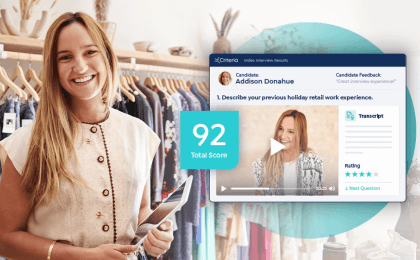
Different roles require different things from an interview. High-volume hiring prioritizes speed, while hiring for senior roles needs live, two-way conversation. Look for a flexible tool that supports asynchronous (one-way) video, real-time video, and AI-conducted interviews on the same foundation. Using one scoring methodology across all formats means every candidate is judged by the same standard no matter who they interviewed with.
2. Asynchronous video interviews for screening at scale
Phone screens are one of the biggest time sinks in recruiting. Async video lets candidates record responses on their own time, on any device, while your team reviews on theirs. Done well, it can turn a 20-minute phone screen into a 5-minute review that provides the same strength talent signal. Look for a pre-built question library so structure doesn’t require starting from scratch.
3. Built-in scoring rubrics
The value of conducting a structured interview comes from consistent scoring metrics. Behaviorally Anchored Rating Scales (BARS) define strong, average, and weak answers look like, so reviewers rate against clear behaviors instead of personal preference. Scoring rubrics are one of the biggest drivers of consistency, and it gives you a common hiring language across interviewers.
4. Explainable AI scoring
AI can score interviews lightning fast compared to a human panel, but “black box” AI scoring create risk. Hiring decisions require transparency and must be easily explained to create legal defensibility. Look for AI scoring that is rubric-based and shows its work, ideally in tandem with human ratings.
5. Bias controls built into the workflow
Bias reduction shouldn’t rely on good intentions; the right interviewing tool builds it directly into the process. Features like blind review (masking names, hiding video, disguising voice), independent evaluation (where reviewers score before seeing each other’s ratings), and guardrails on protected characteristics. These controls make fair hiring the default instead of an extra step.
6. Independently audited AI governance
If a tool uses AI in hiring decisions, it’s imperative to understand how that AI is governed. Look for external certification, such as ISO 42001 for AI management systems, along with data protection standards like ISO 27001 and compliance with GDPR and CCPA.
7. Live interview support that stays in one tab
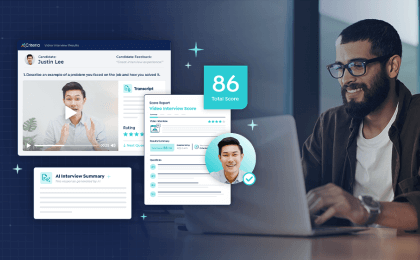
For live interviews, the best tools combine two-way video, structured guides, scoring, and AI-generated transcripts and summaries in one browser window. Features like key moments, searchable transcripts, and “ask anything” queries mean nothing gets lost between the interview and the offer. Prefer solutions with no bots joining the meeting, which candidates generally find less intrusive.
8. Audit-ready documentation and ATS integration
A structured process only pays off if it’s documented and connected. Look for consent capture, retention controls, a full decision trail, and integrations that push scores and notes into your applicant tracking system automatically. Criteria integrates with 50+ ATS and HRIS partners, so interview data feeds the same system your team already uses.
How to Evaluate Tools in Practice
Before you commit, run your toughest role through a demo. Ask:
- Can we use the same rubric and scoring approach across every interview format?
- How are AI scores generated, and can reviewers see the reasoning?
- What bias controls are on by default, and which require manual setup?
- Is the vendor’s science and AI governance independently validated?
- Does the interview connect to assessments before it and development tools after the hire?
That last question matters more than it seems. Interviews are strongest when they’re one input in a continuous picture of the candidate, not an isolated step.
Why Criteria Is Built for This
Our Predictive Interviewing platform turns every interview into a talent signal, combining structured interviews, AI intelligence, and human judgment in a single workflow. Criteria’s Predictive Interviewing platform is built this way, with Async Video, Real-Time Video, and an AI Interview Agent. AI scoring evaluates candidates as accurately as an expert grader, and includes transcripts, summaries, and insights.
Criteria is ISO 42001 certified, and every tool is validated by an I/O psychology team, so claims about fairness are audited rather than just asserted. Leverage the full suite of products with validated assessments during the application process, highly predictive interviewing, and talent insights post-hire. Criteria customers report hiring success rate of 82% compared to a 54% national average.
See It in Action. Book a demo to see the power of Predictive Interviewing firsthand.
Frequently Asked Questions about Structured Interviewing
What is the difference between behavioral and situational interview questions?
Behavioral questions ask candidates to describe what they actually did in past situations ("Tell me about a time you..."). Situational questions present a hypothetical scenario and ask what the candidate would do. Structured interviews can use both, as long as each has a rubric.
How do you score structured interviews consistently?
Score every answer against a behaviorally anchored rubric, have each reviewer rate independently before discussing, and compare ratings across interviewers. Rubric-based AI scoring adds a second, consistent read, with human reviewers keeping the final decision.
- Use the same rating scale for every question.
- Score during or right after the interview, not days later.
- Keep reviewers blind to each other's ratings until all have scored.
- Review disagreements against the rubric, not personal impressions.
Criteria states that people, not AI, make hiring decisions. Its AI scoring is meant to augment human judgment.
How do you train hiring managers on structured interviewing?
Train hiring managers on why structure works, walk them through the rubric using real sample answers, and have them practice scoring before live interviews. Tools that put questions, guides, and scoring in front of the interviewer reduce how much memory and discipline the process demands.
How do you interview at scale without sacrificing quality?
Use async video for first-round screening so every applicant answers the same questions on their own time, then reserve live structured interviews for finalists. This keeps quality consistent while cutting the scheduling and interviewer fatigue that high-volume hiring creates.
What is the difference between async and real-time video interviews?
Async interviews are recorded by candidates on their own time and suit screening at scale. Real-time interviews are live two-way conversations, better for senior or complex roles. The strongest setups use both on one scoring standard.
Can video interviews replace phone screens?
Yes, for most screening. Async video gives every candidate the same questions and lets your team review on its own schedule, often in about 5 minutes instead of a 20-minute call. Keep live conversations for later rounds where two-way discussion matters.
Can structured interviews reduce hiring bias?
Yes, they reduce it. Standard questions, rubrics, blind review, and independent scoring limit the influence of first impressions and personal preference. No process eliminates bias, so pair structure with monitoring and human oversight.
Can AI be used fairly in interviewing?
Yes, when it is rubric-based, explainable, independently audited, and paired with human review rather than replacing it. Criteria's Interview Intelligence scores from the interview transcript only, excluding audio, video, and other information that could introduce bias.
How do you combine structured interviews with pre-employment testing?
Use validated assessments early to measure ability and potential, then use structured interviews to verify skills and probe fit against the same competencies. Connecting both in one platform gives you a continuous picture of each candidate instead of isolated steps.
How should you evaluate structured interviewing tools in a demo?
Run your toughest role through a demo and ask:
- Can we use the same rubric and scoring approach across every interview format?
- How are AI scores generated, and can reviewers see the reasoning?
- Which bias controls are on by default, and which need manual setup?
- Is the vendor's science and AI governance independently validated?
- Does the interview connect to assessments before it and development tools after the hire?
That last question matters more than it seems. Interviews are strongest as one input in a continuous picture of the candidate.