
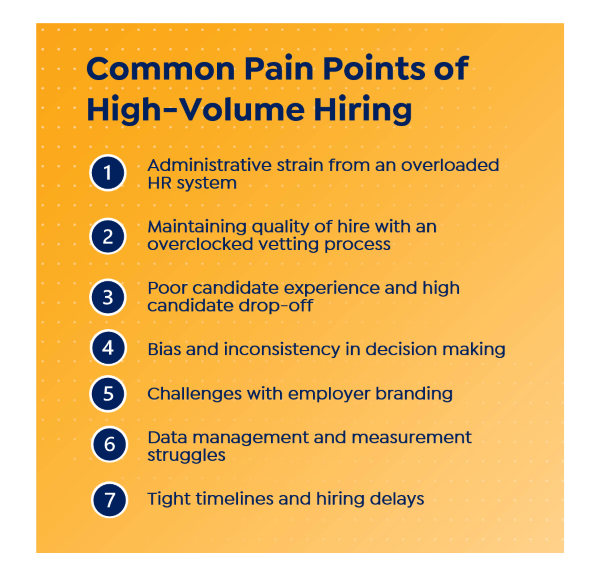
Across industries, organizations are currently crushed by an avalanche of applicants vying for a limited number of positions. High-volume hiring—recruiting processes that involve screening and evaluating hundreds or thousands of candidates for multiple positions within a short timeframe—is as much a blessing as it is a curse: you know strong candidates are somewhere in that digital mountain of applications, but reviewing them all can feel like finding a needle in a hiring haystack.
An HR system flooded hundreds (or even thousands) of applicants causes problems throughout the recruitment funnel. Recruiters struggle to sift through and find the best candidates to move forward, hiring managers get bogged down by the time it takes to effectively evaluate each candidate, teams burn out waiting for new hires to join fill the gaps, and candidates feel left in the dark about the status of their applications.
Without the proper tools and processes in place, high-volume hiring can overwhelm even the most seasoned HR team.
Core Best Practices for High-Volume Hiring:
- Create accurate, skills-focused job descriptions
- Use knock-out questions to reduce spam applications
- Deploy objective assessments early in the process
- Replace phone screens with asynchronous video interviews
- Conduct structured interviews with standardized questions and scoring
- Make data-driven selection decisions
- Continuously evaluate and refine your hiring process
To navigate a sea of candidates, implementing the best practices for high-volume hiring at every point of recruitment ensures that you're moving forward with the cream of your crop.
At the Application Stage
Create accurate and relevant job descriptions
Improving your quality of hire starts before your first applicant ever applies. Get your hiring journey started on the right foot by carefully considering the job requirements and most essential skills for success and working them into the job description. Once you've crafted a description focused on job-relevant skills, it's time to post it!
Reduce Spam with Knock-Out Questions
Knock-out questions are screening questions designed to immediately disqualify candidates who don't meet essential job requirements. To weed out spam applications, include a few basic knock-out questions that will limit the number of bot-sent applications. This can mean including a simple Captcha and adding a couple of personalized questions to the initial application form. With generative AI enabling smarter bots, simple knock-out questions are a good way to reduce the number of non-viable applications you'll receive.
Gather objective insight with assessments
Use objective assessments early on in your hiring process to reliably evaluate the skills and competencies of the candidates apply. Validated assessments provide valuable insights that can help you determine which applicants have the highest potential to succeed at your organization.
At the Interview Stage
Swap phone screens for early video interviews
Phone screens are an outdated way to vet candidates. The average phone screen takes 10-20 minutes and those call times add up fast when recruiters are juggling a large volume of candidates.
Phone Screening vs. Assessment-Based Screening:
| Method | Time for 100 Candidates | Key Limitations |
|---|---|---|
| Traditional Phone Screens | 8+ hours of call time (at 5 min/call), plus dialing, note-taking, and ATS updates | Missed calls, scheduling conflicts, inconsistent evaluation |
| Asynchronous Video Interviews | Candidates complete on their own time; reviewers assess in batches | Requires technology adoption |
| Automated Assessments | Minutes to deploy; results available immediately | Best for skills that can be objectively measured |
Asynchronous video interviews allow candidates to answer questions on their own time and for reviewers to gain deep insight without the heavy time investment upfront. AI-powered review tools can evaluate all candidate submissions immediately, equally, and as accurately as an expert human review. 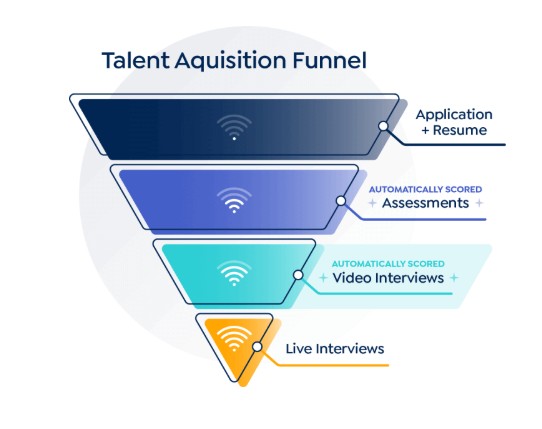
With this approach, no hidden gems will go undiscovered by your hiring team. Once applications are closed, you'll get a shortlist of the top candidates to focus your time and energy on.
Use structured interviewing during live interviews
Once you've narrowed your list of candidates, it's time for a more in-depth interview. Structured interviews are twice as predictive as standard conversational interviews, creating a fairer and more objective interview process for your candidates while helping your organization hire the strongest talent. This approach involves asking each candidate the same job-relevant questions in the same order, grading their responses with the same rubric.
Structured interviews were previously thought to require a heavy lift to implement (especially for high-volume recruitment), but modern hiring platforms like Live Interviewing from Criteria make it easy to conduct tightly structured interviews at scale using extensive question libraries, tailored interview guides, and easy-to-use scoring rubrics.
At the Selection Stage (and Beyond)
Trust the data, not your gut
Objective data is essential for fair, consistent, and predictive hiring. Validated, science-backed assessments and AI-powered scoring move hiring decisions beyond instinct. With real-time reports and intuitive analytics, you can easily compare candidates to benchmarks or top performers, ensuring decisions are evidence-based.
This data-driven approach reduces bias, lowers the risk of mis-hires, and streamlines hiring, making it easier to spot high-potential candidates. Ultimately, using objective data leads to better hires, improved retention, and a stronger workforce.
Regularly reevaluate the process
High-volume hiring is always evolving, so it's important to continually review and refine your approach using analytics and reporting tools. Track key metrics like time-to-hire, source effectiveness, and candidate quality to identify bottlenecks and improve processes. Collect feedback from candidates and hiring managers for a complete view of the experience.
Use these insights to test new strategies or adjust assessments as needed. Continuous improvement, powered by real-time data, keeps your hiring process effective and competitive.
Industry Applications
High-volume hiring best practices apply across many sectors:
- Retail seasonal hiring: Retailers often need to onboard hundreds of associates within weeks before peak seasons. Knock-out questions and early assessments help quickly identify candidates with customer service aptitude.
- Call center recruitment: Contact centers with high turnover benefit from structured interviews and objective assessments to predict which candidates will succeed in fast-paced, customer-facing roles.
- Hospitality staffing: Hotels and restaurants facing rapid hiring demands use asynchronous video interviews to evaluate candidates' communication skills without scheduling bottlenecks.
Key Takeaways for Successful High-Volume Hiring
Ultimately, your organization's hiring goals are to quickly, fairly, and predictably choose the strongest contenders in your talent pool. Leveraging the latest advancements in hiring technology, from best-in-class assessments to AI-assisted interview scoring, can significantly reduce time-to-hire while improving quality of hire.
And remember: high-volume hiring can still be human-led hiring. You just have to equip your team with the tools to save them time, improve their objectivity, and identify the strongest candidates.
How Criteria Can Help
The Criteria platform offers a comprehensive suite of candidate-friendly assessments, Interview Intelligence (IIQ) for asynchronous video interviews, and Live Interviewing tools for structured interviews at scale. Together, these solutions streamline high-volume hiring from application to selection.
Ready to see how the Criteria platform can streamline your hiring process from top to bottom? Start a Free Trial today!
Frequently Asked Questions
What is high-volume hiring? High-volume hiring refers to recruiting processes that involve screening and evaluating hundreds or thousands of candidates for multiple positions within a short timeframe, common in industries like retail, hospitality, and customer service.
How do you screen candidates quickly without sacrificing quality? Use a combination of knock-out questions to filter unqualified applicants, objective assessments to evaluate skills early, and asynchronous video interviews to replace time-consuming phone screens while maintaining consistent evaluation standards.
What are knock-out questions in recruiting? Knock-out questions are screening questions designed to immediately disqualify candidates who don't meet essential job requirements, such as required certifications, availability, or legal eligibility to work. They help reduce the volume of unqualified applications recruiters must review.