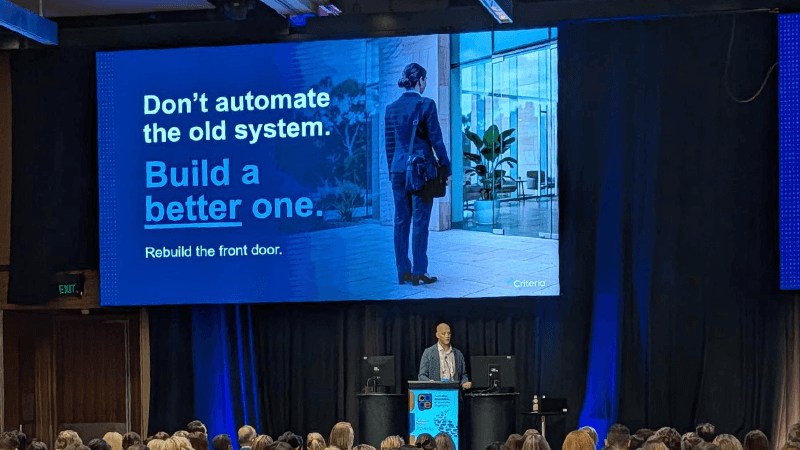
I recently traveled to Sydney for the 2026 AAGE conference and after days of conversations with graduate recruiters, talent leaders, and researchers, I wanted to share the five takeaways I'm carrying home. They apply well beyond Australia to any organization rethinking AI in hiring, candidate screening, and early career recruitment. What’s become clear to me is that AI didn’t break hiring on its own. Instead, it is forcing us to contend with the long-standing problems that have been baked into the hiring process from the beginning.
1. Employers Are Cautiously Optimistic About AI in Hiring
Nobody I spoke with at AAGE is dismissive of AI recruitment technology, but nobody is handing it the keys either. Employers see real promise in saving time, widening the talent pool, and improving consistency, but they are asking hard questions about accuracy, bias, and accountability before they commit.
I think that caution is healthy. If we use AI to speed up a flawed process, we simply reach a bad result faster. Optimism earns its keep when it comes with scrutiny of what the AI is actually acting on.
2. AI Screening Tools Are Becoming a Necessity, and Compliance Matters
High applicant volumes have made AI candidate screening close to unavoidable. Since AI makes it so easy to personalize and send applications, candidate volume has surged, and recruiting teams can no longer review every submission by hand. Employers are fighting fire with fire: AI screening tools have become essential to managing the influx of applications hiring teams face whenever there’s a job opening.
This makes due diligence critical when choosing AI hiring tools. In an AAGE session covering upcoming changes to Australian privacy law, the message was clear: the AI screening tools you choose must be compliant with privacy requirements and legally defensible. You need to ask vendors how decisions are made, what data is used, and how the process can be explained to regulators and candidates alike. Speed is only an advantage if you can stand behind the outcome.
3. The Collapse of Trust in Hiring Cuts Both Ways
The use of AI has made candidates feel filtered out without human consideration, while employers doubt the accuracy of the resumes they receive. AAGE's own data shows candidates using AI to enhance applications rose from 27% to 42% between 2025 and 2026, so polish is now essentially free. Meanwhile, 59% of candidates said guidance on AI use in recruitment is insufficient. Even the machines play favorites: research suggests AI screeners prefer resumes written by their own model 23% to 60% of the time, which penalizes candidates for being authentic and avoiding AI altogether.
Rebuilding trust starts with transparency and objective signals. Pat Dunlop's session on redesigning candidate assessments for AI asked organizations to decide whether they will Forbid, Advise, Insulate or Reimagine AI use in hiring. Whichever you choose, say it plainly at the start of your process. Employers should tell candidates where and how AI is used, and candidates deserve clear guidance on what is acceptable in return. Pair that openness with measures of real ability, such as cognitive aptitude assessments, personality test, and job simulations, rather than self-reported claims.
4. Investing in Early Graduate Recruitment Builds the Workforce of the Future
Entry-level careers cannot be the sacrificed at the altar of efficiency. It may be tempting to let AI absorb the tasks that once trained new hires, but organizations that do so will find themselves without experienced talent to promote in the years ahead. Every senior leader started as a junior one.
This is why employer investment in early careers deserves protection. I was lucky to graduate at a moment when my field was hot, and luck should not decide who gets an opportunity. Hiring graduates for potential and developing them post-hire is how you build a talent pipeline AI cannot replace.
5. This is an Opportunity to Redesign Hiring from the Ground Up
The pandemic forced us to rethink the daily commute to the office, and in the process of redesigning how we work in the wake of Covid, we discovered we did not always need one. AI is doing the same to hiring. Today's process rewards polish, pedigree, and prestige, none of which reliably predict success on the job. AI has made those signals cheap to produce and easily feigned, and in doing so has shown how fragile they were to begin with. In fact, research shows that 46% of new hires fail within the first 18 months. That means that just 54% succeed on the job, which means that a status quo hiring process is only slightly better than a coin flip at predicting future success.
We need to seize the opportunity to rebuild hiring around what matters: cognitive aptitude, curiosity, personality, and work ethic, measured at scale through job simulations and science-backed assessments. It also casts a wider net, giving talent from any background a fair shot at climbing the career ladder.
Trust the Signal: The Path Forward for Hiring in the Age of AI
Every takeaway from AAGE 2026 points to the same conclusion: trust is the foundation of hiring in the Age of AI, and you create trust by measuring what’s real. When polish is free and resumes look identical, the signal that matters is objective evidence of how someone thinks, works, and is likely to perform.
Criteria is ready for this moment. Our science-backed assessments measure the durable skills that predict on-the-job success, and our approach is built to be transparent, defensible, and fair, so employers can screen at scale without losing candidate trust.
The companies that act now will not just survive the AI era of hiring; they will define it. If you are ready to rebuild around signals you can trust, let's talk.