
Criteria Cognitive Aptitude Test (CCAT)
Measures:
- Critical thinking
- Problem solving skills
- Learning ability
- Ability to digest and apply new information
Recommended for:
- Any mid- to high-level jobs that require problem solving.
Job Seekers: Click here for CCAT help
Test Description
The CCAT® is a pre-employment aptitude test that measures an individual's aptitude, or ability to solve problems, digest and apply information, learn new skills, and think critically. Individuals with high aptitude are more likely to be quick learners and high performers than are individuals with low aptitude. The CCAT consists of 50 items; very few people finish all 50 items in the 15 minute time limit. The CCAT is one of the most popular employment aptitude assessments in the United States, having been administered more than 10 million times.
Score Reports
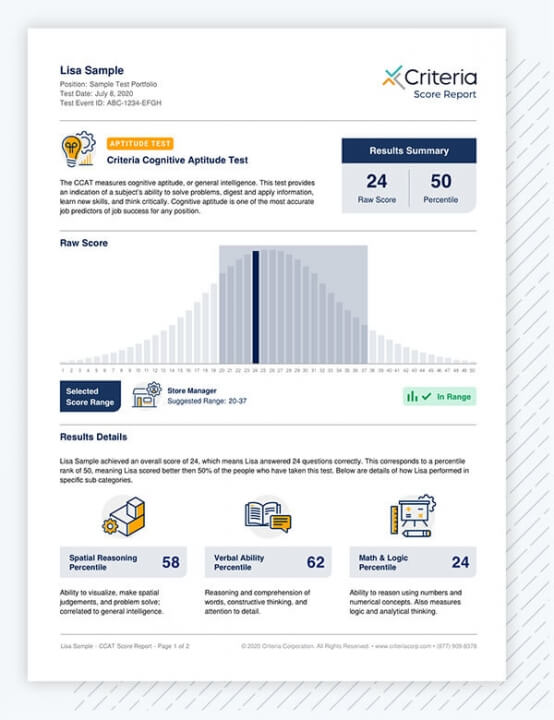
Each individual is given a raw score and a percentile ranking. The raw score indicates how many questions (out of 50) the individual answered correctly, while the percentile ranking is a relative performance metric that indicates how the individual scored relative to others who have taken the test. For example, a percentile ranking of 45 means than an individual scored better than 45% of the group on which the test was normed.
Aptitude as a Predictor of Performance
Research shows that cognitive aptitude is one of the most accurate predictors of job success: 1.6x as predictive as unstructured job interviews and 4.4x as predictive as years of experience.
Sample CCAT Question:
If a plane travels at a speed of 400 miles per hour, how many hours will it take to travel 3000 miles?
A. 5
B. 6
C. 6.5
D. 7
E. 7.5
Answer: E
Validity Information
Construct Validity: The CCAT has been shown to be highly correlated to other leading measures of cognitive aptitude. Correlations with leading employment aptitude tests range from .55 to .8.
Predictive Validity: Various studies have shown that CCAT results correlate significantly with job performance for a wide variety of jobs, but it is an especially effective predictor of performance for jobs that require enhanced abilities in the areas of problem-solving, learning, critical thinking, and verbal and mathematical reasoning. Examples of jobs for which the CCAT has high predictive validity include managerial positions, software engineers and other technology workers, financial analysts, auditors, and many others.
More Details
In order to enhance test security, the CCAT is a dynamic assessment that draws on an item bank of thousands of individually optimized test items. Because the CCAT has been validated as an effective predictor of performance across many roles and industries, the assessment also includes custom score ranges for a wide variety of positions.
Languages Offered:
- English (US) - Default
- English (UK)
- For more languages, visit the UCAT, the language-independent version of the CCAT