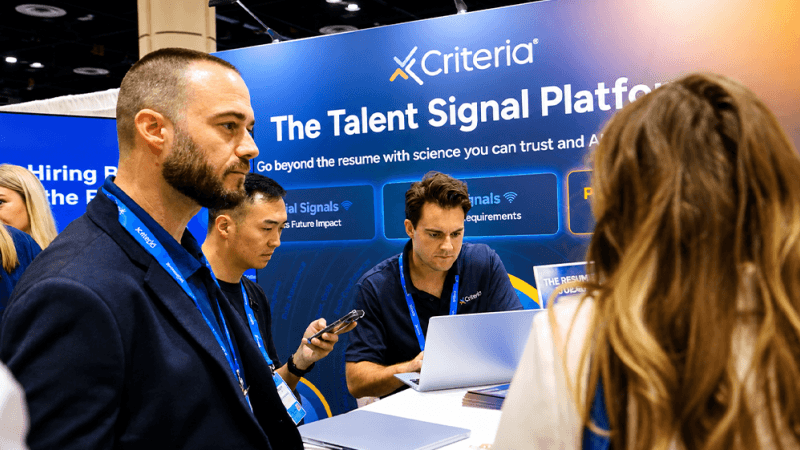
Something shifted at SHRM26 this year. Nearly 20,000 HR professionals filled the Orange County Convention Center in Orlando this June, Criteria Corp's team among them, and almost nobody was asking whether to use AI in hiring anymore. That question, the one that dominated every panel and hallway conversation a year ago, had quietly disappeared. In its place was a harder, more useful one: how do you actually do this well.
A few themes stood out.
Responsible AI is Becoming the New Standard
Nobody in Orlando was debating whether AI belongs in hiring anymore. That argument is settled. What's replaced it is a harder set of questions: what is a tool actually optimizing for, who's checking its work, and can someone explain the outcome to the person it affects.
Having AI in the stack stopped being impressive a while back, since almost every employer has some version running quietly in the background by now. What actually sets organizations apart is whether they can explain what that tool is doing when someone pushes back, and whether a real person is still making the final call instead of waving the output through.
That's a much heavier lift than adoption ever was. Someone has to document what a model is weighing. Someone has to audit it for bias on a real schedule, not just once at launch and never again. And someone needs a recent, specific example of overriding it, not a job title that implies they could.
Regulation is starting to catch up to this expectation. Local laws like New York City's Local Law 144, Colorado's AI Act, and the employment provisions in the EU AI Act are early signs of where oversight is headed more broadly. Employers who built responsible practices in from the start are mostly just filling out paperwork to confirm what they were already doing. Employers who treated it as an afterthought are now scrambling to build a case for their process after the fact, which is a much harder spot to be in.
The Future of Work is Still Human
The resume was never a great predictor of who'd actually be good at a job, and AI has made that weakness impossible to ignore. Application volume has climbed sharply across most industries over the past year, and a lot of that volume is AI-assisted in some way. AI-generated resumes are just part of the applicant pool now for most employers, and the concern coming up most often isn't exaggerated skills or bias. It's AI-written content quietly masking whether a candidate can actually do the work.
AI is genuinely great at speed and pattern recognition. That's what it's built for. But it can't pick up on someone going unusually quiet in meetings for three weeks running, and it can't sit with two priorities that genuinely conflict and make the kind of call that only comes from real context. Judgment, adaptability, the kind of communication that builds trust over time, leadership that shows up specifically when the next step isn't obvious, these are getting more valuable, not less. A resume was never built to show any of that. Performance is.
Candidate Experience is Becoming a Competitive Advantage
The best employers are using technology to make hiring feel more human, not less. Response times are faster, communication about where someone stands is clearer, and interview scheduling no longer requires six back-and-forth emails. Candidate experience is starting to get the same treatment customer experience already gets, as a real differentiator rather than something nice to have. In a market where a strong candidate is often juggling three or four employers at once, the experience of applying is starting to decide who says yes.
That plays out in small moments as much as big ones. A candidate who hears back within a day, gets a clear sense of timeline, and never has to guess where they stand walks away with a different impression than one who submits an application into a black hole. The employers getting this right treat every touchpoint, the confirmation email, the scheduling link, even the rejection note, as part of the brand itself, not paperwork to get through. That's a lot easier to say than to actually build, but the ones who've built it are starting to see it show up in offer acceptance rates.
Hiring Teams Need Better Signals, Not More Candidates
Attracting applicants isn't the problem anymore. AI-generated resumes and one-click applications have made volume the easy part, and made it a lot harder to find the right person buried inside that volume. The real challenge now is signal: a faster, more reliable way to tell who can actually do the job, built earlier in the process instead of hoping it surfaces somewhere around round three.
A lot of hiring teams are still catching up to this. Adding more filters to an applicant tracking system doesn't solve a signal problem, it just pushes the noise further down the funnel. The teams making real progress are rethinking where in the process they're actually gathering evidence in the first place. Often that means moving a skills check or a structured conversation much earlier, before volume gets unmanageable, instead of hoping a resume-based first pass gets it right.
Skills are Replacing Assumptions
This connects directly to the point above. The 2026 Lighthouse Research & Advisory Talent Acquisition Trends Study, produced in partnership with Criteria Corp, found that skills or work-based assessments have become the most trusted alternative to resumes, with 58% of employers relying on them, followed by structured interviews at 50% and work samples or simulations at 43%. What those three approaches have in common is that none of them take a candidate's word for it. Each one puts a person in front of real work and watches how they actually think it through.
Candidates seem just as ready for this shift. According to the same study, 68% of candidates would rather go through a hiring process that doesn't center on the resume at all. That lined up with what was showing up across sessions in Orlando too, where employers described moving past the resume and toward direct evidence of job-relevant skill. A title or a degree shows where someone has been. It doesn't show what they can actually do.
Where This Leaves Us
Put these five threads together and a clear picture emerges. How organizations use AI, and what they still need people for, has become the real story this year, far more than adoption itself. The employers ahead of the curve aren't the ones running the flashiest tech. They're the ones who can explain what their tools are doing and stand behind the decisions that follow, while still leaning on human judgment to build a process that respects a candidate's time and proves, with real evidence, that the person they're hiring can actually do the job.
These five ideas aren't really separate. Responsible AI and skills-based hiring both come down to trusting evidence over assumption. Candidate experience and the emphasis on human judgment both come down to treating people like people. What ties all of it together is a hiring process built to hold up under scrutiny, whether that scrutiny comes from a regulator, a candidate, or just a hiring manager who wants to know they made the right call.
That's the throughline coming out of SHRM26, and it's the one likely to keep shaping how the industry talks about talent for the rest of the year.